
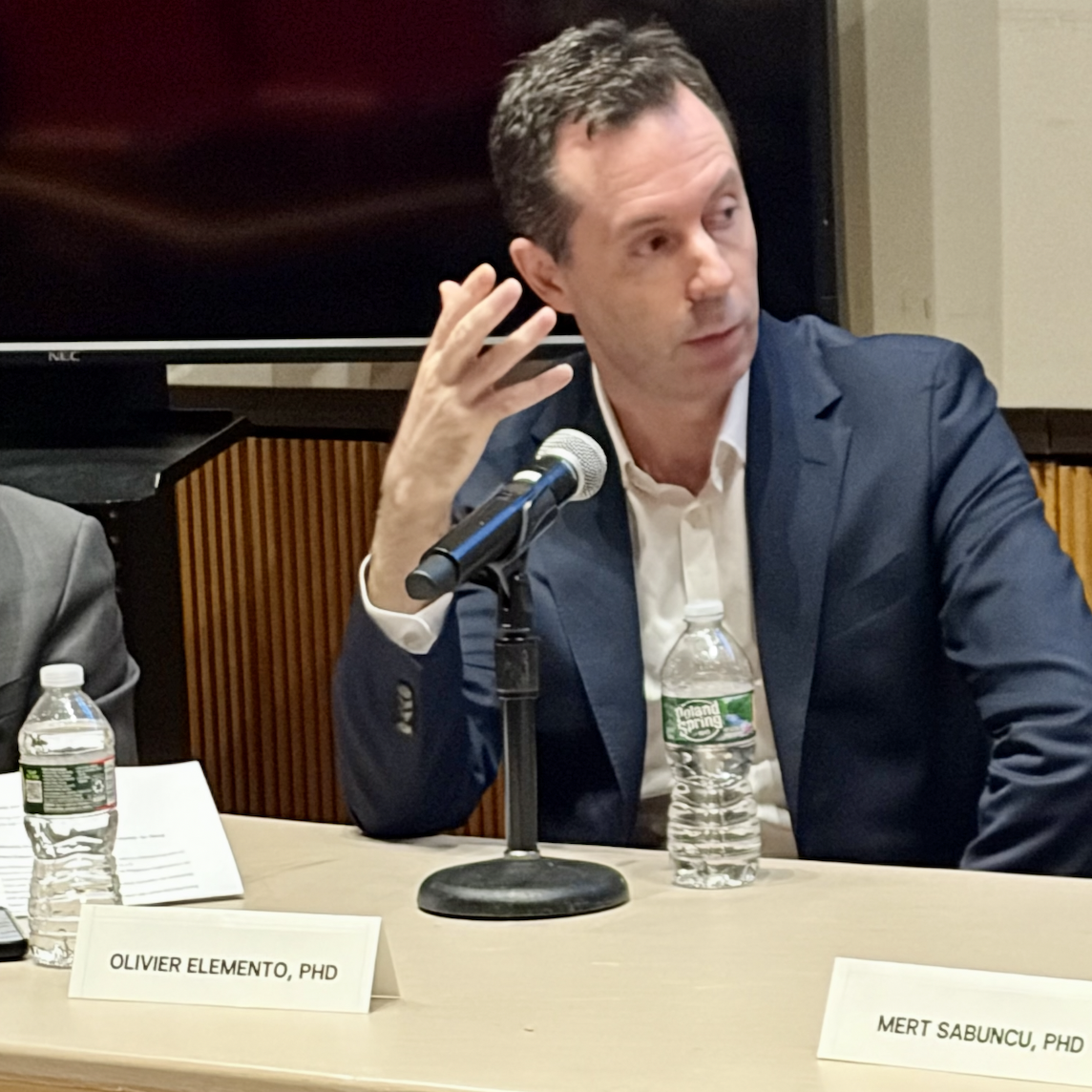
On April 28, EIPM Director Olivier Elemento, Ph.D. joined an all-star panel of Weill Cornell Medicine experts for “AI to Advance Medicine: From Research to Practice,” moderated by Fei Wang, Ph.D., the Associate Dean of Data Science and Artificial Intelligence at Weill Cornell.
 In his opening remarks, Dr. Elemento explained how the EIPM approaches AI differently. “We specialize in generating more data from patients and samples using genomic and spatial technologies to build detailed maps of disease,” he said. “Once we have it, we use AI tools to predict how patients are going to respond to therapy. We also use AI to diagnose patients. We have an exciting project, for example, that uses patient voice and sounds to diagnose whether they're developing conditions including Alzheimer's or Parkinson’s diseases.”
AI to Advance Basic Research
Beyond the clinic, the EIPM is using AI to advance basic science. “I think the biggest impact of AI is going to come from how we use AI for basic research,” said Dr. Elemento. “We're using AI tools combined with robotics to create hypotheses, then using robots to test those hypotheses and generate data at scale from cells, including human cells.”
He added that the goal is to better understand how cells respond to drugs, especially in clinical models of disease, by combining large-scale data generation with AI models.
What Makes Weill Cornell Medicine Unique?
 The panel discussed what makes Weill Cornell Medicine, along with its partners Cornell University and Cornell Tech, uniquely positioned to study AI and develop new clinical interventions.
“Using AI to gain critical insights is happening all over the three institutions,” said Dr. Elemento. “At many universities, there’s a wall between research and the clinic, and I don’t think that exists here at Weill Cornell. That’s a major advantage.”
At the same time, panelists acknowledged challenges that must be addressed for AI research to reach its full potential.
“I see two main issues,” Dr. Elemento said. “We have lots of incredible data, but it is too siloed and not accessible enough.”
“I think we need much greater accessibility of our data — whether it’s clinical research data, EHR data, imaging, or research data. It needs to be easier to share across groups and scientists. There is too much fragmentation, and we need a strategy to break down those silos.”
Overcoming Technical Hurdles
Dr. Elemento stressed that high-quality data will become increasingly important as AI tools become more widely available.
“We are entering a world where AI is basically free,” he said. “Anybody can create software to build an AI model. But the real value lies in quality data and in having access to enough data to create competitive, reliable models.”
He argued that centralizing data access is critical. “We need a strategy to have all of our data in the same place and make it extremely easy for scientists and clinicians to access,” he said. “That’s a real problem we need to address.”
 The discussion also focused on the need for more graphics processing units (GPUs) to support AI research. “We really need to invest in additional GPUs,” Dr. Elemento said. “Companies like OpenAI are building data centers with millions of GPUs. That’s an extreme example, but we need far greater access to GPUs so we can train AI models and remain competitive.”
Panelist Bethany Percha, Ph.D., Chief Data and Analytics Officer, New York-Presbyterian, asked Dr. Elemento whether barriers to data access were primarily technical or administrative.
“I think it starts with governance,” he responded. “There’s too much ownership of data. We need to make sure people who created the data are part of the process, but we also need to avoid situations where one group feels it is the sole owner of the data. That’s preventing our ability to efficiently create amazing AI models.”
He added that the governance challenge is harder to solve than the technical one. “Rethinking ownership of data in this new age of AI is something we need to think much more about,” he said. “We can do better.”
Demonstrating Clinical Utility
Dr. Elemento also highlighted the challenge of implementing AI models in clinical care.
“The testing and assessment of AI models in a clinical setting represents both a challenge and an opportunity for Weill Cornell,” he said. “We need to specialize not just in implementing models, but in demonstrating clinical utility.”
He emphasized the importance of hiring clinical researchers focused on validating AI tools and creating a culture that rewards this work. “It’s not happening enough in my opinion,” he said.
The Existential Threat
Dr. Elemento warned that academic medical centers that fail to fully embrace AI risk falling behind.
“Some academic medical centers and hospitals are going to figure out how to use AI to mine their centralized data, and some are not,” he said. “This will become an existential threat to those who fall behind.”
He pointed to major technology companies as examples of organizations that continuously improve through data. “Just look at Amazon,” he said. “They are a data company. The more they learn, the better they become. Medicine hasn’t fully cracked that code yet, but some hospitals will soon.”
What We Can Learn from Stanford, Mayo Clinic, and Mount Sinai
Dr. Elemento noted that Stanford University benefits from its proximity to Silicon Valley and the AI industry. “There is a major advantage to being located where many AI companies are based,” he said. “It creates a natural transfer of expertise between companies and Stanford.”
He added that Weill Cornell Medicine has a similar opportunity through its relationship with Cornell Tech.
Dr. Elemento also praised Mayo Clinic and Mount Sinai Health System for making major investments in AI infrastructure and data integration. “Mount Sinai has built a data link connecting data from different departments into the same space,” he said. “It’s not perfect, but their access to data is much better compared to many other places.”
Where Do We Go From Here?
Dr. Elemento emphasized that leadership commitment is essential. “The reason Mount Sinai and Mayo do this well is because their process is top-down,” he said. “Leadership decided AI was a priority and invested in it.”
“If that’s who we want to replicate, we need to make our data as accessible as possible,” he added. “It’s going to take investment to centralize our data, make it accessible, and address growing concerns around data ownership. I don’t really see another way to do it.”
“I absolutely agree,” said Professor Mert Sabuncu, Ph.D. “While institutions like NYU or Stanford may have the advantage of a single leadership structure, if this becomes a true priority here, I think we can get it done.”
# # #