

The addition of an oral immunomodulatory drug to a commonly employed antibody therapy is more effective against chronic, indolent lymphoma than the antibody alone, according to the results of a Phase 3 clinical trial led by Weill Cornell Medicine and NewYork-Presbyterian investigators. These findings are likely to change the recommendations for treatment of indolent forms of lymphoma.

A Conversation with Dr. M. Laura Martin
May 29, 2019
M. Laura Martin, Ph.D. was recently promoted to the Core Leadership Team at the Englander Institute for Precision Medicine (EIPM) as Ex Vivo Models Director. In this new capacity she will lead efforts in the utilization of patient derived models of cancer, studying the functional impact of genetic and epigenetic alterations in preclinical models, and investigating the potential to translate these findings to clinical relevance.

View EIPM’s National Cancer Research Month Video
May 21, 2019
In recognition of May’s designation as National Cancer Research Month, EIPM Director Olivier Elemento, Ph.D. shares his thoughts on the state of precision medicine in creating next-generation treatment for cancer. Please click here or on the link below to play the video.


EIPM Joins International Cancer Consortium
May 14, 2019
Weill Cornell Medicine’s Englander Institute for Precision Medicine (EIPM) recently joined the Human Cancer Models Initiative (HCMI) and will become one of four Cancer Model Development Centers (CMDCs) in the United States. EIPM is participating in this project through a subcontract with Leidos Biomedical Research, which operates the Frederick National Laboratory for Cancer Research for the National Cancer Institute.

Amazing Things: Ronda Kotelchuck
May 10, 2019
From NewYork-Presbyterian’s Health Matters
When Ronda Kotelchuck learned she had an aggressive form of uterine cancer, she was frightened and anxious about the road ahead.

Meet New EIPM Member Dr. Claire Henchcliffe
April 30, 2019
As Director of the Parkinson’s Disease and Movement Disorders Institute, Claire Henchcliffe, M.D., D.Phil., leads an outpatient program that specializes in the diagnosis and management of movement disorders including Parkinson’s disease. In addition to seeing patients, Dr. Henchcliffe’s multidisciplinary team of neuropsychologists, therapists and allied health professionals conduct a number of clinical trials available for patient participation.

EIPM’s Dr. Davis Earns Diversity Week Award
April 25, 2019
Growing up in Georgia, Melissa B. Davis, Ph.D., was aware of the lack of representation that doctors of color had in her hometown and she was inspired to become a doctor.

AI Approach Optimizes Embryo Selection for IVF
April 5, 2019
A new artificial intelligence approach by Weill Cornell Medicine investigators, including scientists from the Englander Institute for Precision Medicine, can identify with a great degree of accuracy whether a 5-day-old, in vitro fertilized human embryo has a high potential to progress to a successful pregnancy. The technique, which analyzes time-lapse images of the early-stage embryos, could improve the success rate of in vitro fertilization (IVF) and minimize the risk of multiple pregnancies.

Gene Variant and Breast Cancer in Black Women
April 3, 2019
A set of gene variants that originated in Sub-Saharan West African populations may help explain why black women, compared to white women, have worse breast cancer outcomes, according to a new study from a team led by researchers at Weill Cornell Medicine and NewYork-Presbyterian.
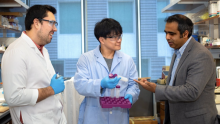
Nanovaccine boosts immunity in sufferers of metabolic syndrome
March 27, 2019
EIPM Member Ankur Singh, assistant professor in the Sibley School of Mechanical and Aerospace Engineering (MAE) and the Meinig School of Biomedical Engineering (BME), and Matthew Mosquera, an EIPM visiting team member and doctoral student in engineering, along with partners from Cornell University in Ithaca published a very interesting paper on how their nanovaccing aids people with metabolic syndrome. The following article is from Cornell Chronicle.