


New Big Data Approach Predicts Drug Toxicity in Humans
November 10, 2017
Researchers can now predict the odds of experimental drugs succeeding in clinical trials, thanks to a new data-driven approach developed by Weill Cornell Medicine scientists. The method detects toxic side effects that may disqualify drugs from human use, giving drug developers an early warning before initiating clinical trials, according to a new study published Sept. 15 in Cell Chemical Biology.

Precision Medicine Is More Than Genomic Sequencing
October 24, 2017
This is an excerpt of a story written by Robert H. Carlson, MBA, appearing on Medscape. Read the original article here.
Basing decisions about cancer treatment on mutations and other somatic genomic abnormalities has become a standard of care for patients with some tumors types, but the use of targeted therapies rarely leads to cure, and responses can be incomplete. If clinical decisions are to improve, both mutation data and cell context—the cellular and genomic milieu in which the mutations are found—must be considered.

Chemotherapy Drives Treatment Resistance in Bladder Cancer
October 17, 2017
Chemotherapy is indicated as the first line of treatment for advanced bladder cancer. New research by Weill Cornell Medicine and University of Trento scientists shows that while chemotherapy kills the most common type of bladder cancer, urothelial cancer, chemotherapy also shapes the genetic evolution of remaining urothelial cancer cell clones to become drug-resistant.

EXaCT-1 Precision Medicine Cancer Test Validated for Clinical Usage
October 3, 2017
A powerful next-generation genome-sequencing test developed at Weill Cornell Medicine can detect mutations that guide precision cancer treatment with over 95 percent accuracy, according to new research.

Dr. Olivier Elemento Appointed EIPM Director
September 15, 2017
Dr. Olivier Elemento, a renowned computational biologist and leader in the field of computational genomics and biomedicine, has been named director of the Caryl and Israel Englander Institute for Precision Medicine at Weill Cornell Medicine. Dr. Elemento will also lead joint precision medicine efforts at Weill Cornell Medicine and NewYork-Presbyterian/Weill Cornell Medical Center.

A parting shot at cancer
June 23, 2017
For those hoping to fire a parting shot at their cancer, the Englander Institute of Precision Medicine (EIPM) has a unique opportunity.
Patients enrolled in precision medicine clinical trials at Weill Cornell Medicine/NewYork-Presbyterian can also consent to have their cases studied after their death.
The lasting legacy is the ultimate way to advance our understanding of cancer biology and contribute to future cures, says neuropathologist David J Pisapia, M.D.

How Mixed Reality is Transforming Collaborative Cancer Research
June 15, 2017
By Tim Hinchliffe. Source: Sociable
The ability to visualize big data in 3D and use that data to collaborate across disciplines through Mixed Reality is transforming cancer research.
As opposed to Virtual Reality (VR), Augmented or Mixed Reality (AR, MR) works by mapping holograms over real, physical space through the help of a head set. With Mixed Reality, you can still see and interact with your immediate environment instead of being absorbed completely in a simulated world like with VR.
A ‘stronger, more holistic’ impact
May 19, 2017
COMPUTATIONAL BIOMEDICINE
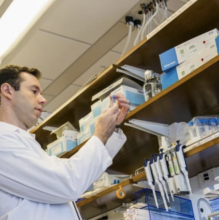
Every patient’s cancer is different. Olivier Elemento, associate director of the HRH Prince Alwaleed Bin Talal Bin Abdulaziz Al-Saud Institute for Computational Biomedicine at Weill Cornell Medicine, hopes to help provide them with highly individualized and precisely targeted treatment.

Three-Pronged Approach Key to Precision Medicine
March 22, 2017
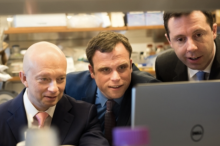
Combining genetic information from a patient’s tumor cells with three-dimensional cell cultures grown from these tumors and rapidly screening approved drugs can identify the best treatment approaches in patients for whom multiple therapies have failed, according to a new study led by Weill Cornell Medicine investigators.